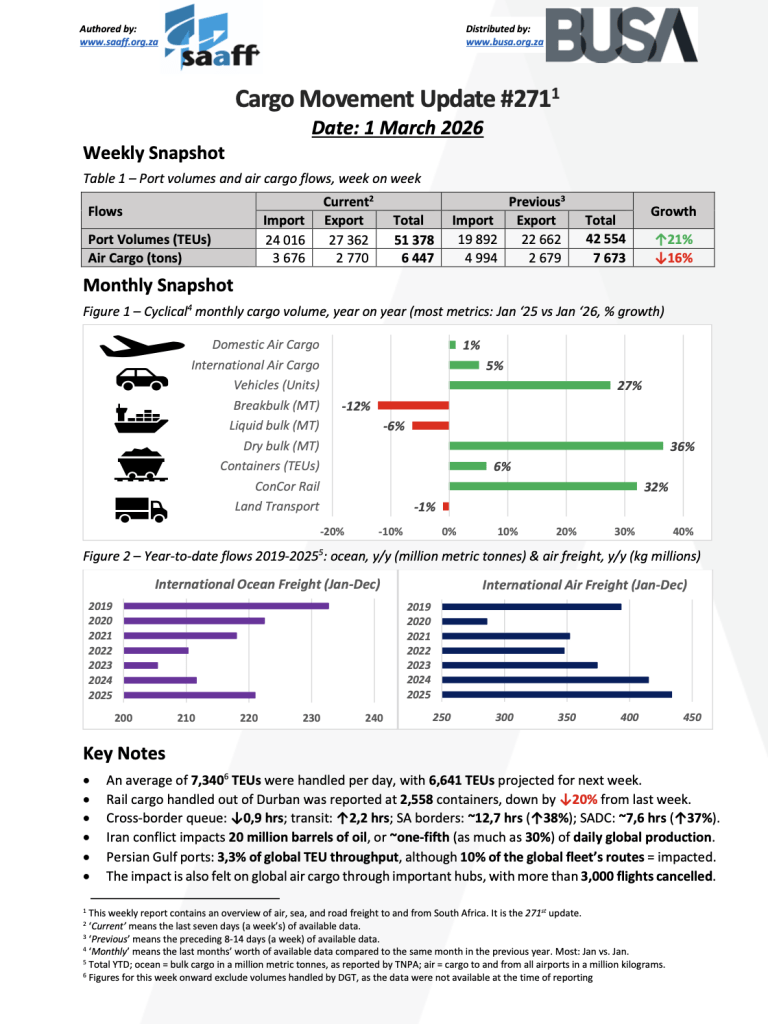

Containers are up by 21% this week; air cargo is down by 16%
Good morning, colleagues and interested parties
We are sharing the latest version of the cargo report for distribution.
The focus of this week’s report revolves around the impact of the Iran conflict:
1. Escalation of the Iran conflict and the effect on global shipping:
a. The Strait of Hormuz—through which roughly 20% of global oil supply (—20 million barrels/day) transits—has experienced a sharp collapse in vessel movements following the escalation of hostilities on 27–28 February 2026.
b. Around 150 crude and LNG tankers have anchored in or around the Gulf while operators assess security and insurance risks; several vessels have been damaged, and traffic through the strait initially fell by ~70%.
c. Container shipping has also been disrupted: approximately 140 container ships (—460,000–470,000 TEU) are effectively trapped in the Gulf, with services transiting the strait representing ~10% of the global container ship fleet.
d. Major carriers have suspended Middle East bookings, halted Gulf port calls, and diverted vessels via the Cape of Good Hope, increasing voyage times by roughly 15–20 days and tightening effective vessel supply, thereby placing upward pressure on freight rates and war-risk insurance costs.
2. Iran conflict disrupts global air cargo networks:
a. Escalating hostilities have triggered widespread aviation disruption, with ~3,000 flights cancelled since the weekend and several Middle Eastern hubs (including Dubai and Doha) experiencing intermittent closures and rerouting of services.
b. Airspace restrictions are constraining both belly-hold cargo capacity and dedicated freighter operations, forcing airlines to reroute around restricted zones, lengthening flight paths and tightening available cargo capacity across major East–West trade lanes.
c. Freight forwarders report space shortages, booking suspensions, and rising rates, as networks are reconfigured and cargo backlogs build.