
Welcome to another Logistics News Update.
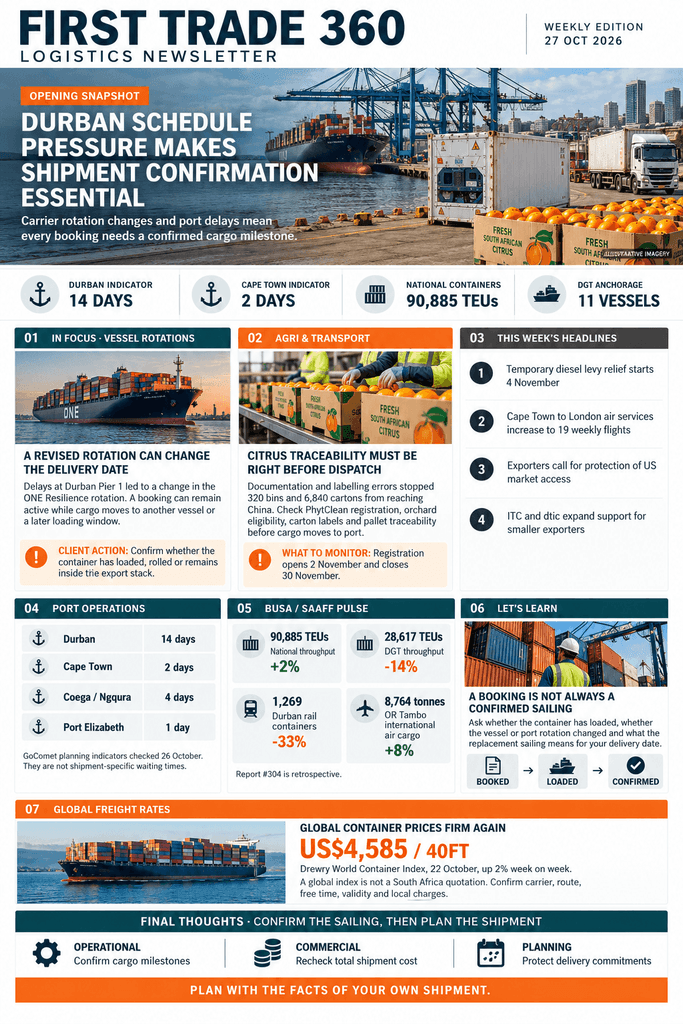
Durban is still the biggest risk for importers and exporters. Port planning indicators checked on 26 October showed Durban at 14 days, Coega at four days, Cape Town at two days and Port Elizabeth at one day. These are planning indicators, not confirmed waiting times for individual containers. Operational feedback from Durban suggests that some vessels are waiting 20 to 25 days before coming alongside, so always ask your service provider for the vessel position, release status, and expected delivery date before you make a commitment to a customer.
The latest BUSA update reported national container throughput of 90,885 TEUs for the week to 18 October, up 2%. Durban Gateway Terminal handled fewer containers than the previous week and approximately 11 vessels were waiting at anchorage. BUSA estimates that affected supply chains could still be carrying more than 18 additional days. Before arranging collection or delivery, confirm that the vessel has arrived, the container has discharged, the carrier has released it, and the terminal can make it available.
Exporters also need to watch vessel rotations. A change to the ONE Resilience’s South African rotation shows that a booking does not guarantee that cargo will load on the planned sailing. If the vessel is delayed or the export stack is too short, the container may move on the following vessel. Citrus exporters are facing tighter traceability checks after labelling and documentation errors prevented some consignments from reaching China during the 2026 season.
The fuel-levy reduction from 4 November should bring some relief to road freight, although it will not immediately remove the higher costs already built into transport rates. Confirm the sailing, the cargo position, and the full cost of the shipment before you promise a delivery date or approve an order.
Agri & Transport Summary
Citrus compliance starts before the container reaches the port
The citrus industry is preparing for the 2027 season after labelling and documentation errors stopped 320 bins and 6,840 cartons from being exported to China during 2026. The problem was not a lack of buyers or vessel space. The records for the fruit, orchard, packhouse and pallet did not meet the destination market’s requirements. Exporters need to check that production units and orchards are registered correctly on PhytClean before dispatch. Packhouses also need to keep pallet information traceable back to the fruit and orchard. Incorrect orchard links, outdated inspection records, and missing information can leave the documents saying one thing while the container holds another.
By the time the container reaches the terminal, the cost of correcting an error can be far higher. The cargo may miss its sailing, product quality may be affected, and the exporter may have to explain the delay to the customer. The CGA has also highlighted the wider pressure facing growers. El Niño conditions, biosecurity risk, market access, reliance on road transport and port delays all affect the ability to move fruit profitably. This is especially difficult for emerging growers because one rejected consignment or delayed payment can place pressure on cash flow for months.
NB!! Online phytosanitary registration for production units and packhouses opens on 2 November and closes on 30 November. Growers must then check and verify their information on AgriOps during January and February 2027.
What to monitor: PhytClean registration, orchard eligibility, carton labels, pallet records, phytosanitary documents, cold-store planning and confirmed export vessel windows.
Logistics & Trade Headlines
- Durban delays force a vessel rotation change. Delays at Pier 1 led to a change in the ONE Resilience’s South African rotation. Cape Town exports may move to the following vessel if the reduced export stack does not allow loading, which shows why exporters need to confirm a booked shipment is still protected on its intended sailing.
- Temporary diesel levy relief starts on 4 November. The fuel levy will reduce by R3 per litre for diesel and R1.50 per litre for petrol until 1 December, before reducing further relief applies until 5 January 2027. The measure may ease cost pressure, although it does not automatically reduce existing transport rates or remove the earlier fuel increases already working through supply chains.
- Cape Town gains more London airfreight connections. IAG Cargo will increase London Heathrow to Cape Town services from seven to 19 flights a week under its winter schedule. Exporters still need to confirm available uplift, cargo acceptance times and the rate applicable to their commodity.
- Western Cape exporters call for action on United States market access. Exporters have urged government to protect preferential access to the United States as uncertainty over AGOA continues. Western Cape exports to the United States reportedly declined 41% over the latest twelve-month comparison, showing why established export markets cannot be replaced quickly.
- Export support agreement targets smaller businesses. The International Trade Centre and the dtic have agreed to work together through 2030 on export readiness, training, market intelligence, and access to regional and international markets. The agreement is a support framework rather than a guarantee of orders, so businesses still need to establish buyer requirements, landed cost and route reliability.
- Durban logistics-property investment signals long-term demand. A R2 billion South Durban Basin investment programme includes planned distribution facilities and hardened container yards. The facilities are targeted for occupation during 2028, so they should be viewed as future capacity rather than an immediate solution to current port congestion.
What to monitor: Confirmed berth windows at Durban and Richards Bay, progress on the ITAC consultation, firm buyer orders rather than enquiries, Saldanha project commitments and developments affecting access to the US market.
Let’s Learn, A Booking Is Not Always a Confirmed Sailing
A freight booking confirms that space has been requested and accepted for a shipment. It does not always mean that the container will load on the vessel originally shown on the booking confirmation. A carrier can revise a vessel rotation when a port call is delayed, when a vessel needs to recover its schedule or when terminal conditions limit the time available for loading. The shipment may remain booked with the carrier while moving to a later vessel or a different port sequence.
Importers should ask whether the supplier’s cargo has physically loaded and request the bill of lading or loaded-on-board confirmation once available. Exporters should ask whether the export stack is open, whether the container has been accepted into the terminal and whether the carrier has confirmed loading. A revised estimated time of arrival is useful, yet the most important answer is whether the shipment is still on the planned vessel.
Ask your forwarder or carrier:
- Has the container loaded on the named vessel?
- If not, what is the replacement vessel and revised sailing date?
- Has the port rotation changed?
- Is the export stack still open?
- Does the revised schedule affect free time, delivery planning, or customer commitments?
Takeaway: Treat a booking as the beginning of the shipment plan. Treat a loaded confirmation as evidence that the voyage has started.
NEWS – IN FOCUS
A Vessel Rotation Change Can Move Your Delivery Date
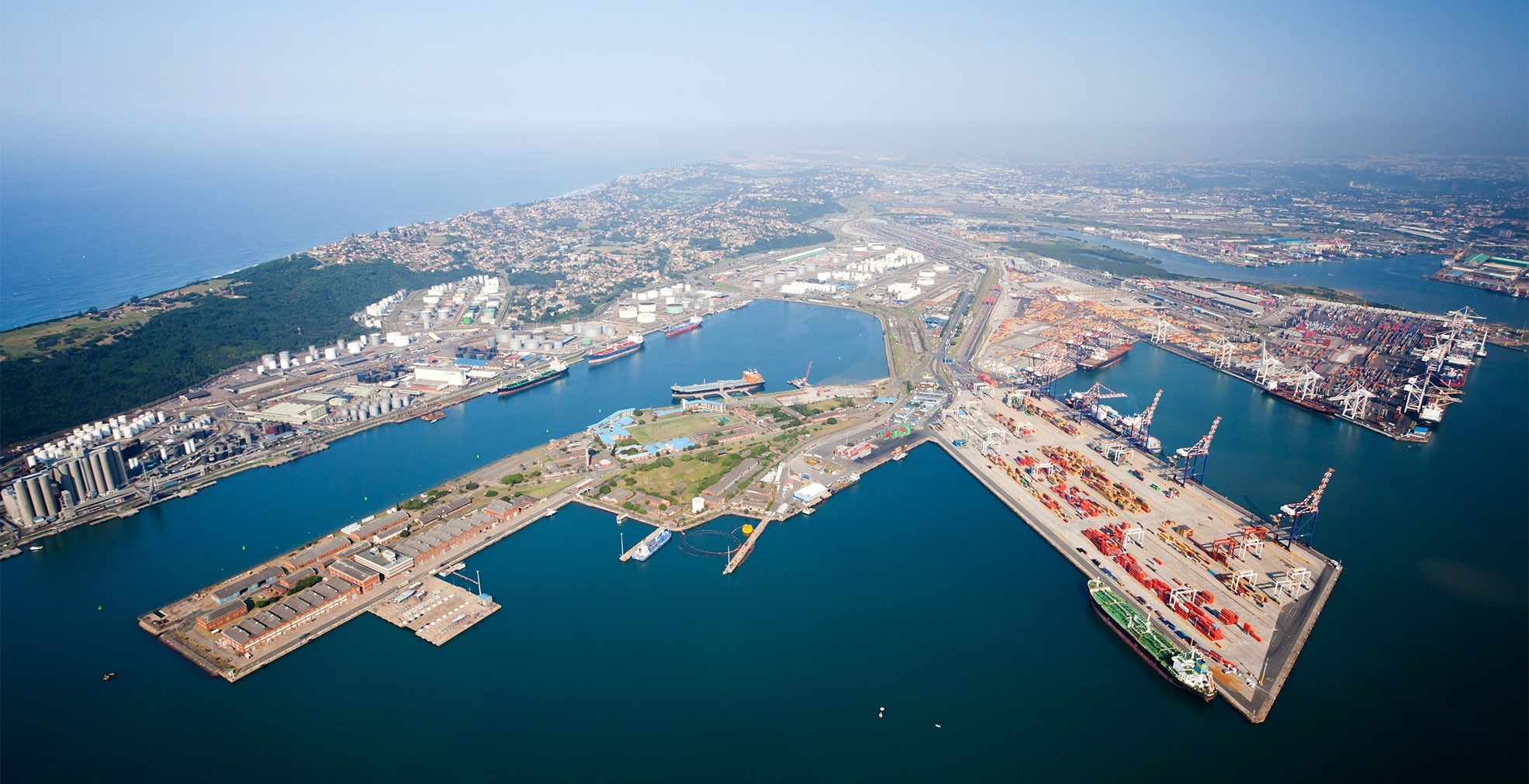
Durban’s congestion is now affecting carrier network decisions as well as individual container movements. On 20 October, Maersk advised customers that the ONE Resilience would change its South African port rotation because of delays at Durban Pier 1. The vessel’s revised route is Coega, Cape Town, Durban, and London. Imports are expected to discharge in Cape Town during weeks 43 and 44, while Cape Town exports may move to the following vessel if there is insufficient time to load during the provisional one-day export stack.
This matters because a vessel still calling at Durban does not mean that every container will follow the original sequence or sailing date. A carrier may alter a rotation to protect the wider service schedule, which can change the discharge port, export loading window, transhipment connection, and final delivery date.
For the period from 12 to 18 October, Durban’s average vessel port call duration was reported at eight days and eight hours. Average vessel waiting time was approximately four days and time alongside averaged approximately four days and eight hours. Road transit on the Johannesburg to Durban corridor remained comparatively steady, which shows that the main risk was at the port rather than on the road corridor.
What this means for importers: Confirm the discharge port, arrival date, carrier release process, onward transport plan and whether any change affects your delivery commitment.
What this means for exporters: Confirm the terminal stack opening date, cargo acceptance, planned vessel, actual loading confirmation and the next available sailing if the container does not load.
Key takeaway: A revised vessel rotation is a commercial event. It can affect stock availability, export-market timing, and the total cost of the shipment.
Port Operations Update:
| Port | Indicator |
| Durban | 14 days |
| Cape Town | 2 days |
| Coega | 4 days |
| Port Elizabeth | 1 day |
These are live port-delay indicators based on schedule disruption and they can change during the day. They do not confirm berth time, container availability, customs release, carrier release, or truck appointment availability for an individual shipment. Durban: The 14-day indicator remains the highest among the major container ports. Importers and exporters should obtain a dated shipment position from the carrier and forwarder before committing to collection, delivery or customer supply dates.
- Cape Town: The two-day indicator is more favourable, although exporters should still confirm stack opening, terminal acceptance, and the vessel’s loading plan.
- Coega / Ngqura: The four-day indicator requires contingency in export and import planning, especially where cargo has a strict connection or delivery requirement.
- Port Elizabeth: The one-day indicator is comparatively favourable, although it does not guarantee berth access or cargo availability.
Key Highlights from Last Week’s Discussions – 18 October 2026
Source: BUSA, SAAFF and global logistics data
Port Operations
National container throughput increased 2% to 90,885 TEUs for the week from 12 to 18 October. Cape Town Container Terminal increased 35% to 15,288 TEUs and Port Elizabeth increased 464% to 7,935 TEUs from a low prior-week base. Durban Gateway Terminal handled 28,617 TEUs, down 14% week on week. Pier 1 handled 15,249 TEUs, up 1%, while Ngqura handled 19,062 TEUs, down 10%.
Key insight: National throughput improved slightly, although Durban Gateway Terminal remained the main constraint in the network.
Durban landside movement
- The report recorded approximately 11 vessels at anchorage and average anchorage delay of 274 hours, or more than 11 days. It estimated that affected supply chains could still carry around 18 additional days because DGT was largely servicing incoming cargo rather than materially reducing the vessel backlog.
- Key insight: Stable yard conditions do not mean the waterside backlog has cleared.
Air Cargo
- OR Tambo handled approximately 8,764 tonnes of international air cargo, up 8% week on week. Inbound cargo eased slightly while outbound cargo increased 20%.
- Key insight: Total airfreight performance can conceal different conditions for imports and exports, so capacity should be confirmed by direction and route.
Rail and Inland Movement:
- Reported Durban rail evacuation declined 33% to 1,269 containers.
- Key insight: Lower rail evacuation can increase reliance on road collection and add pressure to landside operations.
Road and Border Crossings:
- Lebombo processed an average of 1,396 heavy vehicles a day, down 2%. Average queue time decreased to approximately five hours and average processing time decreased to approximately 4.2 hours, although a queue of around 15 kilometres was reported on 15 October.
- Key insight: Weekly averages can improve while individual days still experience material disruption.
Global Shipping Context
- The report noted that 63% of deployed Far East to Europe capacity was operating on services incorporating Red Sea transits. Global port congestion remained elevated with approximately 4.18 million TEUs of containership capacity at anchorage worldwide.
Key insight: Route changes and uneven vessel arrivals can affect capacity and timing before cargo reaches Southern Africa.
Global Freight Rates – Drewry:
| Route | 22 October rate | Weekly movement |
| World Container Index, composite | US$4,585 | Up 2% |
| Shanghai to Rotterdam | US$3,632 | Up 3% |
| Shanghai to Genoa | US$4,152 | Up 5% |
| Shanghai to Los Angeles | US$8,007 | Up 2% |
| Shanghai to New York | US$10,166 | Up 1% |
The index is a global market measure across eight East-West routes. It is not a South Africa freight quotation, and it should not be used to estimate a China to Durban or China to Cape Town shipment without a current carrier quote. For South African importers and exporters, the market message is that global container pricing has firmed again. Confirm the carrier, origin, destination, equipment type, cargo readiness date, free time, validity date, local charges, and every surcharge before committing to a purchase order or selling price.
Final Thoughts
Durban’s pressure is now affecting vessel rotations and cargo timing beyond the terminal gate. This makes shipment-level confirmation more important than general reports of improvement or delay.
- Operational: Confirm whether each priority container has discharged, loaded, or rolled to a later vessel and obtain the revised shipment milestones in writing.
- Commercial: Recheck freight validity, local charges, free time, storage exposure, and fuel-related transport costs when a schedule changes.
- Planning: Build contingency into customer delivery commitments and export programmes where a missed sailing would affect stock availability, production, or product quality.
A reliable supply chain is built by checking what has happened to the actual shipment and who owns the next action.
Brought to you by First Trade 360™, your partner in logistics and Exporters Western Cape.pe
“This information contained herein is being made available for indicative purposes only and does not purport to be comprehensive as the information may have been obtained from publicly available sources that have not been verified by FirstRand Bank Limited (“FRB”) or any other person. No representation or warranty, express, implied or by omission, is or will be given by FRB, its affiliates or their respective directors, officers, employees, agents, advisers, representatives or any other person as to the adequacy, reasonableness, accuracy or completeness of this information. No responsibility or liability is accepted for the accuracy or sufficiency thereof, or for any errors, omissions or misstatements, negligent or otherwise, relating thereto. In particular, but without limitation, no representation or warranty, express or implied, is given as to the achievement or reasonableness of and no reliance should be placed on, any projections, targets, estimates or forecasts and nothing contained herein should be relied on as a promise or representation as to the past or future. FRB does not undertake any obligation to provide any additional information or to update the information contained herein or to correct any inaccuracies that may become apparent. The receipt of this information by any person is not to be taken as constituting the giving of any advice by FRB to any such person, nor to constitute such person a client of FRB.”