
Welcome to another Logistics News Update.
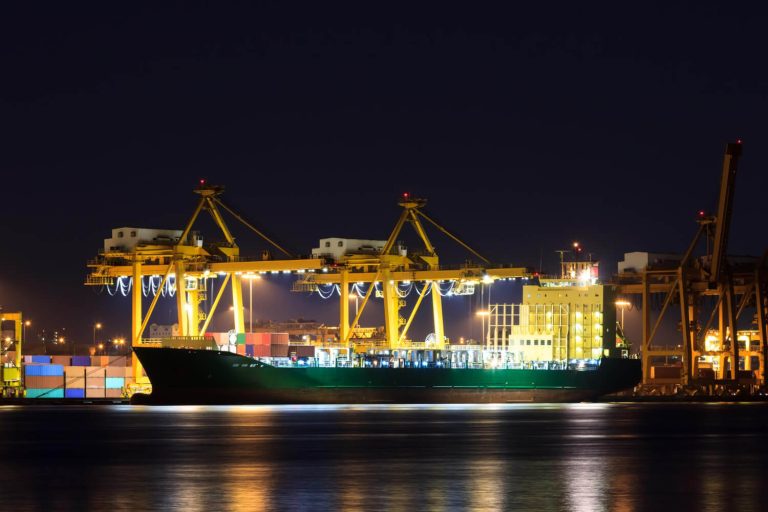
We saw a huge increase in the price of fuel last week which has added to the pain of importing and exporting and on top of this, as we report on what happens at the port, the figures may show 14 days as they do this week in Durban but the reality on the ground is a little different because we have vessels that have been delayed for over 20 days, so when you are planning make sure you keep up to date with the real facts. Now the biggest problem we have is Durban Gateway Terminal, which handles around 46% of the port traffic in South Africa.
The Sunday Times reported “As the country enters the peak import season, fresh concerns have emerged at the DGT, where operational challenges are creating congestion and delays at the country’s busiest container facility. Despite a strong start under the new partnership between Transnet and ICTSI, the implementation of the Navis N4 operating system, coupled with equipment constraints and recent weather-related disruptions, has resulted in longer vessel waiting times and cargo backlogs. Government has now stepped in, with Transport Minister Barbara Creecy calling for urgent corrective action while reaffirming support for major infrastructure investments aimed at improving capacity and long-term port performance. For importers and exporters, the situation serves as a reminder of the continued pressure on South Africa’s logistics network and the importance of proactive supply chain planning in the months ahead.”
So, if there is anything you can take from this it is that planning is essential and you should not always rely on the normal shipping time for critical cargo, so plan for the possible delays. We give you the official published port delays below but always be aware of the operational challenges the transporters face from booking delays, although there is a proposed new system that should help with this.
Agri & Transport Summary
strengthening El Niño is becoming the main planning risk for South Africa’s 2026/27 agricultural season, current forecasts indicate that the event could intensify over the coming months and persist through the summer season. It is still too early to determine the effect on deciduous fruit production or export volumes, while improved soil moisture following last season’s rainfall provides a more favourable starting position.
International buyers from Africa, Asia, the Middle East, Europe, and the United States also explored South African sourcing opportunities during meetings in Durban. Interest included processed agricultural products, food, and beverages. For exporters, buyer interest only becomes a viable order once product compliance, packaging, payment terms, transport capacity, and the delivery route have been confirmed.
What to monitor: Updated rainfall forecasts, planting and crop estimates, buyer enquiries that convert into firm orders, cold-chain capacity and confirmed port performance.
Logistics & Trade Headlines
- Durban and Richards Bay vessel delays remain a corridor risk: For the week ended 4 October, Durban’s vessel port-call time remained above seven days for a fifth consecutive week. Richards Bay anchorage time increased 47% week on week to almost six days. Road conditions on the N3 improved, but vessel delays still require additional time in vessel, collection, and delivery planning.
- International buyers explore South African sourcing: Buyer delegations from Saudi Arabia, Kenya, Egypt, Malaysia, India, Switzerland, the United States and SADC countries met South African suppliers in Durban. Interest covered processed agricultural goods, food and beverages, automotive components, and manufactured products. Buyer interest is encouraging, but export orders still depend on compliance, packaging, payment terms, and dependable logistics.
- ITAC proposes a customs rebate documentation change for manufacturers: ITAC has proposed allowing affected manufacturers to use Form C2 as supporting evidence for certain customs-duty rebate claims when imported component content is destroyed under customs supervision. The proposal would address cases where manufacturers cannot obtain suppliers’ import records. It remains subject to public consultation and is not yet a final rule.
- Saldanha signs 25-year port-land lease: TNPA and Freeport Saldanha signed a 25-year lease covering about 55 hectares in the port’s Southern Precinct. The agreement supports proposed marine, bunkering, energy, manufacturing, logistics and agro-processing projects. The reported R6.9 billion investment pipeline remains prospective, subject to investor leases and construction.
- Vehicle exports fall while domestic demand remains resilient: South African vehicle exports declined 18.8% year on year to 31,473 units in September. Domestic new-vehicle sales grew 12.7% to 61,645 units. The split is a reminder that export performance depends on overseas demand, shipping reliability and competitive production costs, not local sales alone.
- Western Cape exporters flag uncertainty in the US market: Exporters Western Cape called for renewed engagement to protect established United States trade relationships. It cited a decline in Western Cape exports to the US from about R17.31 billion in 2024 to R14.51 billion in 2025. Export diversification remains necessary, but established customer relationships cannot be replaced quickly.
What to monitor: Confirmed berth windows at Durban and Richards Bay, progress on the ITAC consultation, firm buyer orders rather than enquiries, Saldanha project commitments and developments affecting access to the US market.
Let’s Learn, what a Port Delay Indicator Actually Tells You
A port-delay indicator is a planning signal. It estimates how much later vessels are arriving or moving through a port compared with schedule expectations, it does not confirm how long your container will wait, when it will be discharged, or when a truck can collect it. The important distinction is between a vessel delay and cargo availability. A vessel may arrive late, but a container can still need customs clearance, carrier release, terminal discharge, stack positioning, an appointment, and a confirmed transporter before it can leave the port.
Export cargo has a different sequence: a booking does not confirm terminal acceptance, loading or departure.
Where businesses get caught: A customer hears that congestion has improved and assumes the shipment is ready. the delivery date is then promised before the carrier release, terminal status, free-time position, and transport booking have been confirmed.
Hypothetical example: An importer sees a six-day port-delay indicator for Cape Town, the vessel arrives but the container is not discharged for two days, customs documentation requires correction and the next truck appointment is unavailable. The actual delivery date can therefore be later than the six-day indicator suggests.
Practical takeaway: Ask for a dated update on the specific shipment: vessel status, discharge, customs release, carrier release, terminal availability, free days, and confirmed collection appointment.
NEWS – IN FOCUS
Diesel hike puts freight margins under pressure

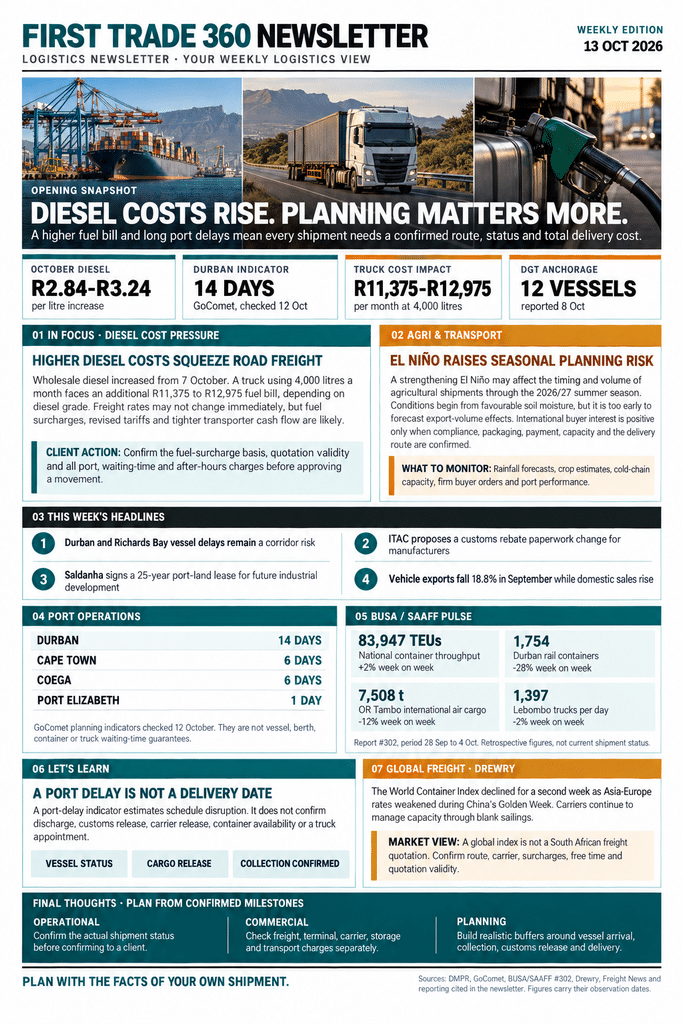
October’s diesel increase is adding immediate cost pressure across South Africa’s supply chain, from last week the 7th October, wholesale diesel rose by approximately R2.84 per litre for 0.05% sulphur diesel and R3.24 per litre for 0.005% sulphur diesel, for a truck using 4,000 litres of diesel a month, the increase adds approximately:
- R11,375 per month for 0.05% sulphur diesel
- R12,975 per month for 0.005% sulphur diesel
Actual prices vary between suppliers because diesel retail prices are unregulated, however, the impact is clear: fuel is one of the largest operating costs for road transport, particularly for long-haul container collections, port shuttles, cross-border movements, and deliveries to inland customers.
Transporters cannot always increase rates immediately and most reply on a fuel levy, many transporters operate under agreed customer tariffs that are only reviewed annually. This means the initial increase may be absorbed through lower margins and tighter cash flow, over time, the cost is likely to appear in revised transport rates, fuel surcharges, or requests to review existing contracts. The increase affects more than trucking companies; importers may face higher collection and delivery costs after cargo is released from a port. Exporters may see higher costs from packhouse to cold store, terminal and customer and agricultural businesses remain exposed because transport costs form part of the total cost of getting time-sensitive cargo to market.
Higher international oil and petroleum-product prices drove the October adjustment, the rand strengthened slightly during the review period, which softened the increase but did not offset it.
WHAT THIS MEANS FOR IMPORTERS AND EXPORTERS
Businesses should not assume that an existing transport quotation will remain unchanged, always confirm the fuel-surcharge and the review period and whether the quoted rate includes current diesel costs, before approving a movement or quoting a customer, check:
- The diesel price and surcharge basis used in the quotation
- Whether the transporter may revise rates during the contract period
- Port, terminal, waiting time and after-hours charges separately from fuel
- The full route, including collection, return, empty-container, and delivery legs
- Whether a delay at the port or border could increase fuel, standing time or overtime exposure
- Whether the delivered price still protects the expected margin
Key takeaway: The diesel increase is not only a transport issue, but it also affects the cost of every road-based handover in the supply chain.
Port Operations Update:
| Port | Indicator |
| Durban | 14 days |
| Cape Town | 6 days |
| Coega | 6 days |
| Port Elizabeth | 1 day |
hese are live port-delay indicators, not guaranteed waiting times for individual vessels or containers. They are not measures of terminal throughput, anchorage time, berth time, container availability, or truck appointment availability.
- Durban: The 14-day indicator remains the highest among the main South African container ports; cargo owners should obtain a shipment-level position from the carrier and forwarder before committing to collection or delivery.
- Cape Town: The six-day indicator requires continued attention for import and export planning. Confirm vessel arrival, terminal acceptance, and weather-related disruption where relevant.
- Coega: The six-day indicator suggests that delay risk remains elevated. Exporters should confirm terminal acceptance and carrier schedule integrity for time-sensitive cargo.
- Port Elizabeth: The one-day indicator is comparatively favourable, but it should not be treated as confirmation of vessel berthing, container availability or truck access.
What to monitor: Daily carrier notices, terminal acceptance, vessel arrival changes, discharge status, stack availability, customs and carrier release, free days, and confirmed truck appointments.
Key Highlights from Last Week’s Discussions – 4 October 2026
Source: BUSA, SAAFF and global logistics data
Port Operations
National container throughput was 83,947 TEUs, up 2% week on week. Durban Gateway Terminal handled 31,409 TEUs, also up 2%. The report’s later operational update through 8 October recorded 12 vessels at anchorage and an estimated 20 to 24 additional days for affected supply chains.
Key Insight: Higher throughput is positive, but it does not by itself confirm that individual containers can be collected or loaded on time.
Rail and Inland Movement
Durban rail movements were 1,754 containers, down 28% week on week.
Key Insight: Lower rail evacuation can increase reliance on road collection and add pressure to terminal landside operations.
Air Cargo
OR Tambo handled 7,508 tonnes, down 12% week on week. Inbound cargo increased 6%, while outbound cargo declined 29%.
Key Insight: Total airfreight movement can conceal different conditions for importers and exporters, so capacity and booking status should be checked by direction.
Road and Border Crossings:
Lebombo processed an average of 1,397 trucks a day, down 2%. Average queue time improved 13% to 4.5 hours and processing time improved 16% to 4.3 hours.
Key Insight: Border performance improved during the reported week, but route-specific conditions and enforcement changes can still affect a shipment.
Global Shipping Context
The report continued to flag Middle East route risk and Red Sea disruption, while Walvis Bay’s connectivity was noted as strengthening its position as an alternative regional gateway.
Key Insight: International disruption can change carrier routing, capacity and transit time before cargo reaches Southern Africa.
Global Freight and Air Cargo Context:
Drewry’s World Container Index was reported at US$4,434 per 40-foot container, down 1%. Global air-cargo chargeable weight fell 4% week on week, while average rates rose 2% to US$3.11 per kilogram.
Key Insight: These are dated international market benchmarks, not quotations or South African freight rates.
Strategic Outlook
Performance across ports, rail, air cargo, and borders remained uneven. Businesses should use the report to understand recent trends, then make shipment decisions using the latest carrier, terminal, and transport information.
What to monitor: Durban evacuation and vessel queues, rail availability, outbound OR Tambo capacity, border conditions by route and carrier responses to international route disruption.
Global Freight Rates – Drewry
The composite index declined for a second consecutive week as Asia-Europe rates weakened during China’s Golden Week. Shanghai to Rotterdam and Genoa have now declined for twelve consecutive weeks, while transpacific rates remained comparatively firm. Carriers continue to manage capacity through blank sailings. Drewry reported 39 cancelled sailings across the major East-West trades between 5 October and 8 November, from 710 scheduled sailings.
Market view: The index shows the direction of selected global spot markets. It is not a South African freight quotation. The actual cost of a shipment depends on its origin, destination, carrier, equipment, surcharges, free time, routing, and quotation validity.
Final Thoughts
- Operational: Confirm the actual status of each shipment before confirming to your client
- Commercial: Separate freight, terminal, carrier, storage, and transport charges, then check free-time exposure and written relief before approving costs.
- Planning: Build realistic time buffers around vessel arrival, terminal availability, collection, customs release, and final delivery.
This week’s message is that an improving indicator is useful, but it is not a shipment commitment. Reliable delivery still depends on confirmed milestones, clear ownership of each handover and early communication when a plan changes. That discipline protects product quality, customer confidence, working capital, and margins.
Brought to you by FNB First Trade™ 360, your partner in logistics and Exporters Western Cape.
Sources and Further Reading
- Diesel hike puts freight margins under pressure, Freight News, 6 October 2026
- Vessel delays weigh on KZN ports, Freight News, 6 October 2026
- Vehicle exports slide as local sales rise, Freight News, 6 October 2026
- EWC urges intervention to protect US export trade, Freight News, 6 October 2026
- El Niño clouds agricultural export outlook, Freight News, 8 October 2026
- Global buyers explore SA sourcing opportunities, Freight News, 8 October 2026
- 25-year lease opens Saldanha port land for development, Freight News, 8 October 2026
- ITAC proposes rebate paperwork fix for OEMs, Freight News, 9 October 2026
- Live port-congestion indicators, GoComet, checked 12 October 2026
- [BUSA/SAAFF Cargo Movement Update #302, reporting period 28 September to 4 October 2026
“This information contained herein is being made available for indicative purposes only and does not purport to be comprehensive as the information may have been obtained from publicly available sources that have not been verified by FirstRand Bank Limited (“FRB”) or any other person. No representation or warranty, express, implied or by omission, is or will be given by FRB, its affiliates or their respective directors, officers, employees, agents, advisers, representatives or any other person as to the adequacy, reasonableness, accuracy or completeness of this information. No responsibility or liability is accepted for the accuracy or sufficiency thereof, or for any errors, omissions or misstatements, negligent or otherwise, relating thereto. In particular, but without limitation, no representation or warranty, express or implied, is given as to the achievement or reasonableness of, and no reliance should be placed on, any projections, targets, estimates or forecasts and nothing contained herein should be relied on as a promise or representation as to the past or future. FRB does not undertake any obligation to provide any additional information or to update the information contained herein or to correct any inaccuracies that may become apparent. The receipt of this information by any person is not to be taken as constituting the giving of any advice by FRB to any such person, nor to constitute such person a client of FRB.”