
Welcome to another Logistics News Update.
There is potentially significant news developing out of China this week around possible direct shipping services into Durban. If implemented this could materially improve transit times and routing efficiency for South African importers, we will keep you updated as more information becomes available.
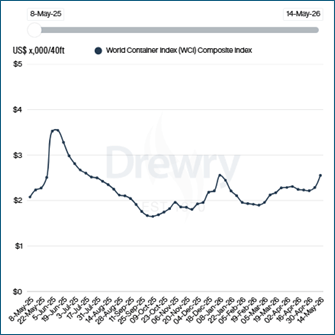
The global logistics environment remains stable from an operational perspective but pressure across the supply chain continues to build. Drewry’s World Container Index increased sharply this week to $2,553 per 40ft container, driven by higher rates on the Transpacific and Asia-Europe trades.
For South African importers and exporters, the biggest challenge is no longer only port congestion or vessel availability. The pressure is increasingly shifting toward inland execution, transport cost management and maintaining control across the full supply chain as volumes increase and winter weather begins impacting operations locally.
At the same time import compliance is becoming a far bigger focus area. The PVoC programme applies to listed products imported from China and requires a Certificate of Conformity before shipment to South Africa, with mandatory enforcement expected after 20 September 2026.
The important point is that the logistics environment is still functioning but the margin for error is reducing. Delays in documentation, transport planning, supplier readiness, or cargo coordination are becoming more expensive and more disruptive.
The common theme across this week’s update is that global supply chains are still moving but the cost of poor planning, weak coordination and delayed execution is increasing very quickly.
Agri & Transport Summary
South Africa’s citrus export season is accelerating quickly, with the industry warning that inland logistics pressure is becoming one of the biggest operational risks facing exporters. Recent industry discussions have highlighted growing concern around road transport dependence as export volumes continue to increase across major corridors. The Citrus Growers’ Association has warned that rising diesel costs and limited rail capacity are placing increasing pressure on farming margins and export competitiveness. Industry representatives estimate that citrus exports could reach approximately 209 million cartons this season, increasing pressure on transport infrastructure and container availability.
Rail reform continues to dominate logistics discussions within the agricultural sector. Exporters are pushing for faster implementation of rail access and corridor reform as dependence on road transport continues to increase cost exposure across the supply chain.
There was also positive news for exporters this week, with the citrus industry moving closer to the implementation of Performance Based Standards (PBS) vehicles, also referred to as smart trucks. The industry believes these higher-capacity vehicle combinations could improve transport efficiency and help manage growing export volumes during peak season movement.
Logistics & Trade Headlines
- South Africa imports compliance enforcement tightening ahead of September deadline: Government continues moving ahead with stronger enforcement against substandard and non-compliant imports, with increased focus on pre-export verification and product compliance requirements.
- Fuel costs remain elevated: Geopolitical uncertainty continues to support higher diesel and inland transport costs as oil prices stay volatile.
- Strait of Hormuz continues presenting operational risk: Vessel movement continues through the region, but security concerns and elevated operational risk remain a factor for global shipping.
- Freight rates hold firm: Drewry’s World Container Index increased to $2,553 per 40ft container, with pricing continuing to be supported by fuel and operating costs rather than strong demand growth.
- Airfreight pricing stays elevated: Ongoing jet fuel costs and network disruption continue supporting higher air cargo pricing despite softer global demand.
- Citrus season accelerates pressure on cold chain and inland transport: Export volumes are building rapidly, placing increased strain on transport execution and cold chain coordination.
- Rail reform calls grow louder: Agricultural exporters continue pushing for faster implementation as road dependency and fuel exposure increase.
- Port performance broadly stable: Durban and Cape Town continue operating within normal parameters despite isolated operational and weather-related disruption.
- Winter weather adding variability at Cape Town: Seasonal weather patterns are beginning to increase operational risk and potential disruption in the region.
- Regional border conditions remain inconsistent: Cross-border queue and transit times continue fluctuating across key corridors, reflecting ongoing structural inefficiencies.
- Inland execution remains the primary operational risk: Transport coordination, fuel costs and road dependency continue placing pressure on delivery reliability and supply chain cost.
Let’s Learn – why cargo inspections happen and what triggers them
Many importers assume cargo inspections only happen when something is wrong, but inspections are a normal part of the import process and can be triggered for several operational or compliance reasons. Obviously if you don’t have all your documents in order, you are guaranteed a custom stop, always pay attention to the documentation.
In practical terms:
Cargo can be stopped or inspected by customs authorities, NRCS, port health, SAPS or other regulatory bodies depending on the type of goods being imported and the documentation submitted. Some inspections are random, while others are triggered by specific risks or inconsistencies.
Where people get caught:
- Incorrect or vague cargo descriptions on shipping documents
- Tariff codes not matching the goods being imported
- Missing permits, certificates or supporting documentation
- Under-declared cargo values or quantity discrepancies
- High-risk or controlled product categories
Quick example:
A shipment can be delayed even when the cargo itself is correct if the commercial invoice, packing list and customs entry do not align properly. In many cases the delay is caused by documentation inconsistencies rather than the goods themselves.
Takeaway:
Inspections are not always avoidable, but unnecessary delays often are. Accurate documentation, correct tariff classification, and proper compliance preparation remain critical to reducing inspection risk and avoiding additional storage, demurrage, and transport costs.
NEWS
SA’s citrus export ‘win’ puts logistics support in focus
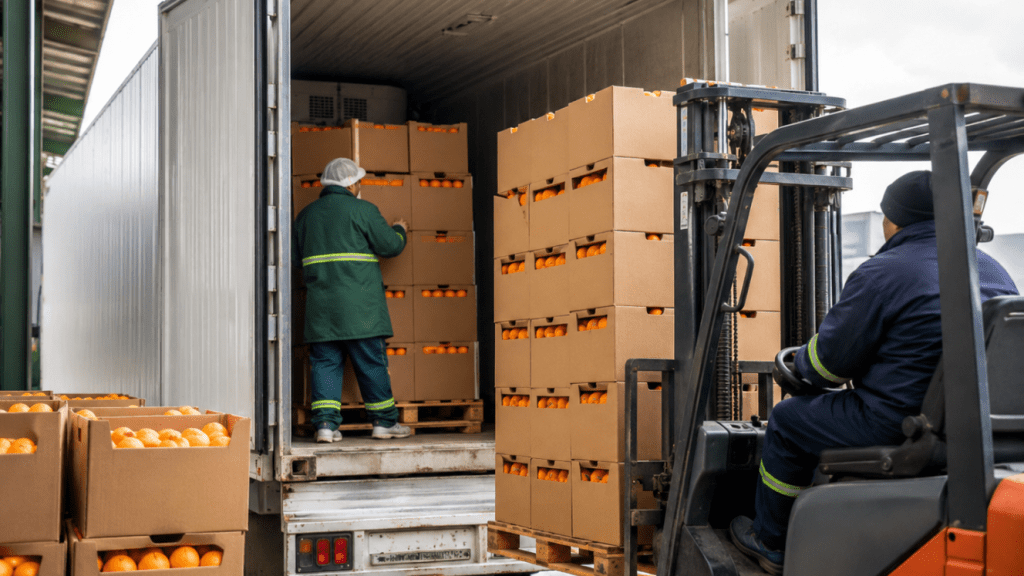
South Africa’s citrus industry has reached a major milestone after officially becoming the world’s largest citrus exporter by volume, overtaking Spain with approximately 2.9 million tonnes exported during 2025. The achievement reflects the continued growth of the local citrus sector and its increasing importance within global food supply chains.
While the export growth is positive for the industry, it has also placed renewed focus on the logistics and infrastructure challenges facing growers and exporters. Industry leaders warned that rising fuel costs, ongoing Middle East instability and shipping disruptions are placing significant pressure on exporter margins and operational planning.
The Citrus Growers’ Association highlighted that logistics support will become increasingly critical as export volumes continue to grow. Concerns remain around rail reliability, inland transport costs, and the ability of the logistics network to support future export expansion efficiently. Exporters are continuing to push for faster rail reform and improved corridor performance to reduce dependence on road transport.
Despite these challenges the industry remains focused on long-term growth, with the CGA’s Vision 260 strategy targeting 260 million cartons of citrus exports by 2032. The sector believes South Africa remains well positioned globally, but future growth will depend heavily on improving logistics efficiency, market access, and supply chain reliability.
Source: Adapted from FreightNews
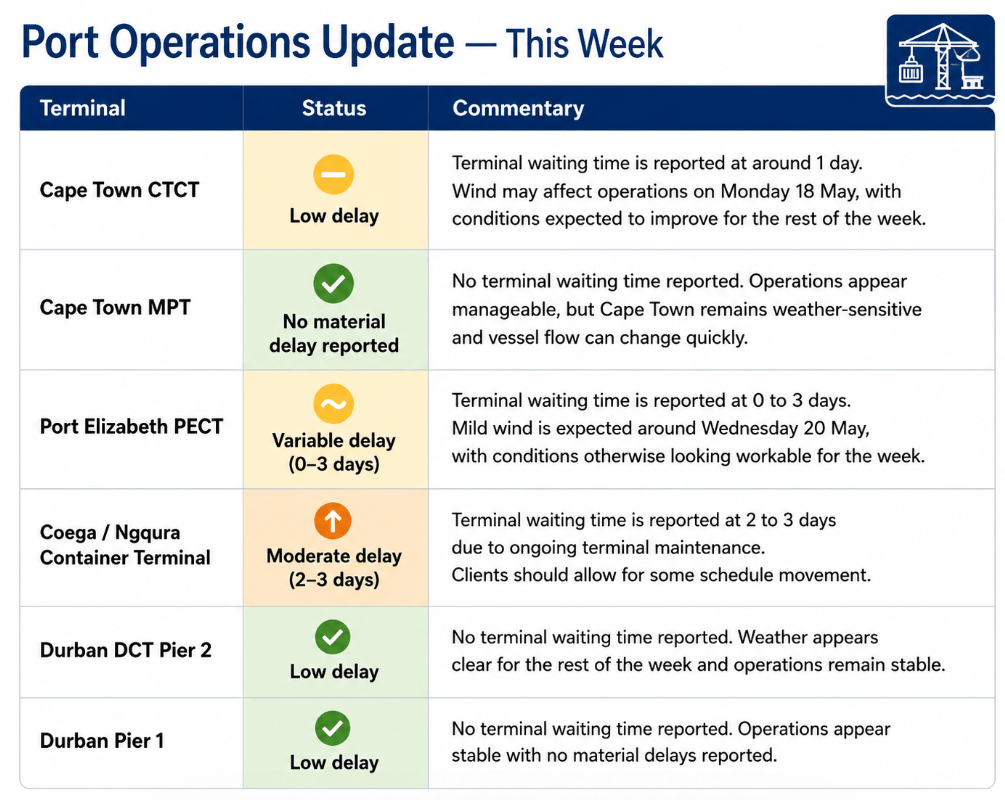
Port Operations Summary: – Port Update:
Winter conditions are starting to play a bigger role in operational planning, particularly around Cape Town where wind and weather-related variability can still affect vessel scheduling and stack planning. Overall port performance remains manageable, with Durban currently stable, while Coega is showing some delay linked to terminal maintenance. The key risk for clients is that weather, equipment flow and inland coordination can quickly tighten execution windows across the supply chain.
Key Highlights from Last Week’s Discussions – 10 May 2026
Source: BUSA, SAAFF, and global logistics data
Port Operations
Port performance softened this week, with overall container throughput declining largely due to weather disruption and reduced operational flow.
• Total container volumes decreased by approximately 12% week on week to 40,226 TEUs
• An average of 5,747 TEUs handled per day, with volumes projected to increase significantly next week
• Cape Town volumes increased despite severe weather disruption, with strong crane and equipment performance reported
• Durban Pier 1 volumes declined, with RTG shortages and equipment breakdowns continuing to impact truck turnaround times
• Port Elizabeth volumes recovered strongly, increasing by approximately 102% week on week from the previous low base
• Rail cargo out of Durban increased by approximately 22% week on week to 2,137 containers
Key Insight: Port operations remain stable overall, but weather disruption and equipment constraints continue placing pressure on execution reliability, particularly across Durban and the Cape regions.
Air Cargo
Airfreight volumes declined slightly this week, although pricing pressure remains elevated globally.
• Total international air cargo volumes through ORTIA decreased by approximately 2% week on week to 5,935 tons
• Inbound cargo volumes declined by approximately 1%, while outbound cargo decreased by approximately 4%
• Global air cargo demand softened following the Mother’s Day flower surge and Labour Day disruptions
• Global spot airfreight rates increased further to approximately $3.29/kg despite weaker volumes
Key Insight: Airfreight demand remains uneven, but elevated fuel and operating costs continue supporting higher pricing despite softer cargo volumes.
Road and Border Crossings
Cross-border performance improved this week, although regional corridor pressure remains elevated.
• South African border crossing times improved to approximately 8.2 hours, down around 6% week on week
• SADC regional crossing times improved significantly to approximately 5.2 hours, down around 32% week on week
• Total indirect border delay costs declined to approximately R576 million for the week, down around 23% week on week
• Significant scanner congestion was reported at Kazungula while operational issues continued at Groblersbrug and Kanyaka
• Heavy goods vehicle traffic through major South African border posts declined by approximately 4.5% month on month
Key Insight: Border performance improved overall, but structural corridor and processing risks remain a major operational concern across regional supply chains.
Ocean Freight and Global Shipping
Global shipping remains operationally stable but constrained by geopolitical risk and elevated cost pressure.
• Strait of Hormuz disruption continues to immobilise approximately 312,812 TEU of vessel capacity within the Persian Gulf
• The disruption remains more regional than the Red Sea crisis, with limited large-scale Cape rerouting reported so far
• Drewry’s World Container Index increased by approximately 3% week on week to $2,286 per 40ft container
• Global container demand rebounded during May, supporting renewed freight rate increases
• Carriers continue managing capacity through blank sailings and operational adjustments as geopolitical risk and fuel costs remain elevated
Key Insight: The shipping market remains stable from a network perspective, but fuel exposure, regional congestion risk and geopolitical uncertainty continue driving pricing and operational pressure.
Strategic Outlook
Operations remain stable locally, but pressure continues shifting toward inland execution, weather disruption, equipment reliability, and fuel-driven cost escalation. Businesses should focus on transport coordination, planning flexibility and operational readiness as winter conditions and export volumes continue building across the supply chain.
Global Freight Rates
Drewry’s World Container Index surged by approximately 12% this week to around $2,553 per 40ft container, marking the strongest increase in several weeks. The increase was driven by higher freight rates across both the Transpacific and Asia – Europe trades as carriers implemented Emergency Fuel Surcharges, Peak Season Surcharges, and additional capacity controls.
On the Asia – Europe trade, rates increased sharply following further carrier capacity reductions and stronger early peak season demand. Shanghai to Genoa increased by approximately 20% while Shanghai to Rotterdam increased by approximately 11%. Carriers continue attempting to push higher FAK rates into the market as cargo bookings increase and available vessel space tightens.
On the Transpacific trade, rates also increased significantly this week. Shanghai to New York increased by approximately 14% while Shanghai to Los Angeles increased by approximately 10% following the implementation of additional fuel and peak season surcharges by major carriers. Carriers continue actively managing capacity through blank sailings and sailing adjustments as operating costs remain elevated.
The impact of the Middle East situation remains visible through elevated bunker fuel costs, operational risk, and growing pressure on carrier operating costs rather than direct disruption to South Africa’s primary trade lanes. Drewry noted that geopolitical disruption linked to the US/Israel-Iran conflict is contributing to earlier peak season movement and tighter vessel space across key trades.
Overall, the market remains operationally stable, but pricing pressure has clearly strengthened again. Freight rates are now moving upward due to a combination of fuel costs, carrier surcharge implementation, early peak season demand and continued geopolitical uncertainty.
Disclaimer: The information provided in this newsletter is based on reliable sources and has been carefully verified. This Logistics News is distributed free of charge. If you wish to unsubscribe from our mailing list, please reply to this email with “unsubscribe” in the subject line. Please note that all content is adapted or directly quoted from its original sources. We take no responsibility for any inaccurate reporting; we are only adapting the news for you.
This week’s news was brought to you by:
FNB First Trade 360 – a digital logistics platform and Exporters Western Cape
“This information contained herein is being made available for indicative purposes only and does not purport to be comprehensive as the information may have been obtained from publicly available sources that have not been verified by FirstRand Bank Limited (“FRB”) or any other person. No representation or warranty, express, implied or by omission, is or will be given by FRB, its affiliates or their respective directors, officers, employees, agents, advisers, representatives or any other person as to the adequacy, reasonableness, accuracy or completeness of this information. No responsibility or liability is accepted for the accuracy or sufficiency thereof, or for any errors, omissions or misstatements, negligent or otherwise, relating thereto. In particular, but without limitation, no representation or warranty, express or implied, is given as to the achievement or reasonableness of, and no reliance should be placed on, any projections, targets, estimates or forecasts and nothing contained herein should be, relied on as a promise or representation as to the past or future. FRB does not undertake any obligation to provide any additional information or to update the information contained herein or to correct any inaccuracies that may become apparent. The receipt of this information by any person is not to be taken as constituting the giving of any advice by FRB to any such person, nor to constitute such person a client of FRB.”