
Welcome to another Logistics News Update.
The market has shifted quickly over the past few days as disruptions in the Middle East begin to impact real cargo movement. What started as a geopolitical event is now affecting routing, capacity and cost across both sea and air freight.
What to expect:
- Extended lead times as vessels reroute around the Cape
- Reduced airfreight capacity and longer routing
- Upward pressure on both sea and air rates
- Increased risk of congestion at key ports
If you are bringing goods from the middle east, plan and book shipment now, try your best not to leave it “last minute”. Have a backup plan. If you can’t get goods out of this region, look at other regions.
In other news, the citrus industry has urged for stronger biosecurity. The Citrus Growers’ Association of Southern Africa (CGA) has emphasised the critical role of biosecurity in protecting agriculture and supporting export-led economic growth, drawing lessons from the ongoing Foot and Mouth Disease (FMD) outbreak, something to watch.
Let’s Learn: What Happens If the Strait of Hormuz Closes and Does It Affect Container Traffic?
The Strait of Hormuz is one of the most critical shipping routes in the world. Around 20% of global oil supply moves through this narrow passage between the Middle East and the rest of the world. If it closes, the impact is immediate, but not always in the way people expect. Don’t be fooled, shipping lines may increase rates “just because”
What actually happens:
• Oil prices spike quickly due to supply disruption
• Fuel costs increase globally, which pushes up shipping costs
• Insurance premiums rise for vessels operating in the region
• Carriers may reroute or avoid the area depending on risk levels
Does it affect container shipping directly?
Not significantly in terms of physical container volumes.
Most container routes between Asia, Europe, and Africa do not rely on the Strait of Hormuz. They move via the Suez Canal or around the Cape.
Where it does affect containers:
• Higher bunker fuel costs increase freight rates globally
• Surcharges may be introduced by carriers
• Schedule reliability can be impacted due to rerouting or congestion elsewhere
• Middle East ports (like Jebel Ali) can face disruption, affecting regional cargo flows
Playbook:
Do not look at this as a route issue, look at it as a cost and risk issue. Monitor fuel-driven surcharges, review pricing regularly, and build flexibility into landed cost models.
Logistics & Trade Headlines
- Shipping disruption escalates as carriers reroute via the Cape: Major container lines have begun diverting vessels away from the Suez and Middle East routes due to security risks. MSC has suspended bookings into certain regions, and rerouting via the Cape is adding transit time and cost pressure.
- Global risk now shifting from rates to reliability: The focus has moved from low freight rates to schedule disruption. Rerouting, congestion risk, and security concerns are now the main drivers of uncertainty.
- Durban volumes starting to recover post-Chinese New Year: Activity is picking up as vessels return, but early signs of landside pressure are re-emerging as truck volumes increase.
- Cape Town remains weather-driven and unpredictable: Continued wind disruption has led to intermittent stoppages, with delays impacting export cargo, particularly in the agricultural sector.
- Post-Chinese New Year demand now translating into space pressure: Carriers are reporting tighter space on Asia trades, with bookings increasing and early signs of rate movement starting to come through.
- Freight rate direction turning short term: While rates have been under pressure, the combination of rerouting and tightening capacity is now creating upward pressure in certain lanes.
- Rail constraints continue to push cargo onto road: Limited rail capacity remains a structural issue, increasing reliance on road transport and adding pressure to port operations.
- Regional corridors becoming more relevant: Maputo and alternative routing options continue to gain traction as businesses look to reduce reliance on congested South African ports.
- Airfreight remains stable and reliable: Volumes are holding, with rates relatively steady, offering a dependable option for urgent or high-value cargo.
- Trade policy and geopolitical risk driving decisions: Ongoing global tension and policy shifts are now directly influencing routing, pricing, and supply chain strategy.
NEWS
Container lines reroute via Cape, MSC suspends bookings
27 Feb 2026 – FreightNews

Mediterranean Shipping Company has instructed all vessels operating in the Gulf to seek safe shelter amid heightened tensions. Source: Bloomberg
Global container lines have reacted quickly to the escalating Middle East conflict, with immediate operational changes now affecting trade flows. MSC has suspended all bookings to the Middle East until further notice, while multiple carriers including Maersk, CMA CGM and Hapag-Lloyd are rerouting vessels away from the Suez Canal and Strait of Hormuz, opting instead for the longer route around the Cape of Good Hope.
This is being driven by a rapidly deteriorating security environment, with carriers prioritising vessel and crew safety. Ships already in the region have been instructed to seek safe positions, and new bookings into high-risk are either paused or heavily restricted.
The shift back to Cape routing is significant. It adds transit time, reduces available capacity, and introduces new cost pressures through war-risk premiums and emergency surcharges. Source: FreightNews
Port Operations Summary: – Port Update:
Durban 0 days
Cape Town 7 Days
Port Elizabeth 0 days
Coega 2-5 Days Source: Maersk
Key Highlights from Last Week’s Discussions – 22nd February 2026
Source: BUSA, SAAFF, and global logistics data
Port Operations
Airfreight strengthened week on week, with strong inbound and outbound movement.
- Total volumes up around 10% week on week
- Inbound up around 11%, outbound up around 9%
- Volumes remain significantly above last year and pre-pandemic levels
Takeaway: Airfreight remains a strong and reliable option, especially for time-sensitive cargo.
Air Cargo
Airfreight activity slowed modestly overall, with softer imports and stronger exports.
• Total international volumes declined slightly week on week.
• Inbound cargo eased, while outbound demand improved.
• January volumes remain above last year, although still below pre pandemic levels.
Takeaway: Air cargo remains structurally resilient. Export flows are providing support despite a slower start on imports.
Road and Border Crossings
Conditions are mixed, with some improvements but ongoing structural pressure across the region.
• Lebombo volumes up around 5% with stable queue times
• Border crossing times in SA increased slightly to around 9.2 hours
• SADC delays worsened significantly, up around 26%
• Beitbridge congestion has returned, with delays of up to 7 days
• New tolls and compliance requirements adding cost in certain corridors
Takeaway: Short-term flow is stable locally, but regional inefficiencies and delays remain a serious risk.
Ocean Freight and Global Shipping
Market conditions remain weak, with continued pressure on rates despite carrier intervention.
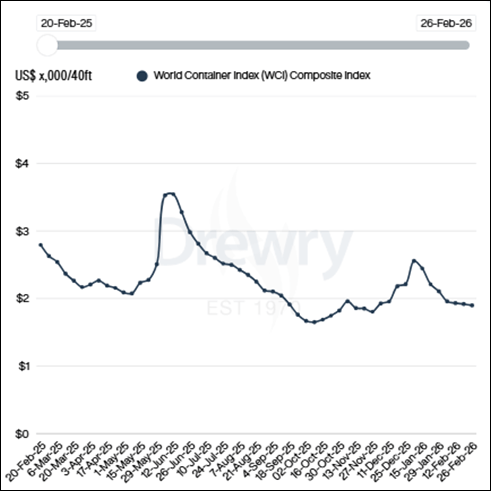
• Rates down for a sixth consecutive week to around $1,919 per 40ft container
• Overcapacity remains the key issue despite blank sailings
• Carriers pushing rate increases of around $1,000 per FEU, with limited impact
• Schedule reliability slightly down, with delays averaging over 5 days
Takeaway: The market remains oversupplied. Even with carrier intervention, rates are under pressure and recovery is limited in the short tered to continue into early 2026.
Global Freight Rates
Weekly Container Rate Update – 26 February 2026
Drewry’s World Container Index decreased 1% to $1,899 per 40ft container this week.
Disclaimer: The information provided in this newsletter is based on reliable sources and has been carefully verified. This Logistics News is distributed free of charge. If you wish to unsubscribe from our mailing list, please reply to this email with “unsubscribe” in the subject line. Please note that all content is adapted or directly quoted from its original sources. We take no responsibility for any inaccurate reporting; we are only adapting the news for you.
This week’s news was brought to you by:
FNB First Trade 360 – a digital logistics platform and Exporters Western Cape
“This information contained herein is being made available for indicative purposes only and does not purport to be comprehensive as the information may have been obtained from publicly available sources that have not been verified by FirstRand Bank Limited (“FRB”) or any other person. No representation or warranty, express, implied or by omission, is or will be given by FRB, its affiliates or their respective directors, officers, employees, agents, advisers, representatives or any other person as to the adequacy, reasonableness, accuracy or completeness of this information. No responsibility or liability is accepted for the accuracy or sufficiency thereof, or for any errors, omissions or misstatements, negligent or otherwise, relating thereto. In particular, but without limitation, no representation or warranty, express or implied, is given as to the achievement or reasonableness of, and no reliance should be placed on, any projections, targets, estimates or forecasts and nothing contained herein should be, relied on as a promise or representation as to the past or future. FRB does not undertake any obligation to provide any additional information or to update the information contained herein or to correct any inaccuracies that may become apparent. The receipt of this information by any person is not to be taken as constituting the giving of any advice by FRB to any such person, nor to constitute such person a client of FRB.”